This summer, I travelled to Türkiye. While there, I spent some time in Göreme, in the Cappadocia region. Cappadocia is known for its hot air balloons and its unique landscape—stunning cone-shaped rock formations (called fairy chimneys). But, the history of Cappadocia is just as captivating as its beauty. The region is rich in history, particularly regarding Christian heritage. With historians suggesting that Christianity arrived in the region as early as 1 AD, it became an epicentre of early Christian learning. Scattered throughout the region are hundreds of ancient cave churches and monasteries that were built into the rock formations, dating between the 4th–13th centuries AD. The region is also home to various underground cities that were dug to offer protection in times of persecution, during periods of Roman oppression and later Arab raids.
I had a wonderful time hiking through the valleys of fairy chimneys, wandering in and out of old cave churches, decorated with fading paintings and frescos, and visiting Derinkuyu Underground City. It was so mesmerizing, but I still found it a bit difficult to wrap my head around just how far back this history and these structures date.
It was particularly fascinating to visualize these early Christians gathering in these spaces, envisioning how they worshipped, what church and fellowship looked like for them. It really puts into perspective how our spaces and traditions have evolved over time, to the “church” that we are familiar with today, yet one that is still changing, evolving: how we worship, where we gather, etc.
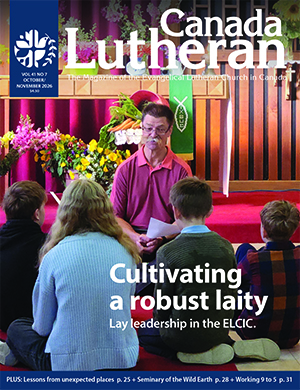
This issue’s feature is an exploration into one of the ways in which we are seeing this kind of transformation, through the gifts of lay leadership. It particularly shines a light on the life and ministry of lay-led congregations.
Lay leadership within the ELCIC—however it may look like—and the ministry of our laity is foundational to the life of our church. As the landscape of our church continues to shift, as we continue to reimagine our spaces, as how we worship continues to transform, one of the most proactive and affirming actions we all can take is continuing to uplift the gifts of our laity in our congregations and communities.
The “pastor shortage” has certainly been a topic of much conversation in our church as of late. If your congregation is currently without a pastor, I believe this feature offers valuable insight into the possibilities and functionality of lay-led congregations. Even if your congregation has a full-time rostered leader, this feature serves as a wonderful source of inspiration for the many possibilities that arise through a robust laity.
Happy reading!
Sarah Malina
Editor